
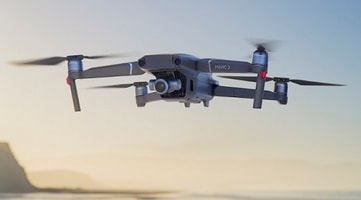
The regulations for consumer drones are coming, but they’re not here yet.
Criminals are no longer restricted to burner phones, guns, and getaway cars. They’re finding new, sophisticated ways to smuggle contraband, conduct counter-surveillance, and retaliate against those who threaten their schemes.
The biggest growing trend among criminals? Using drones.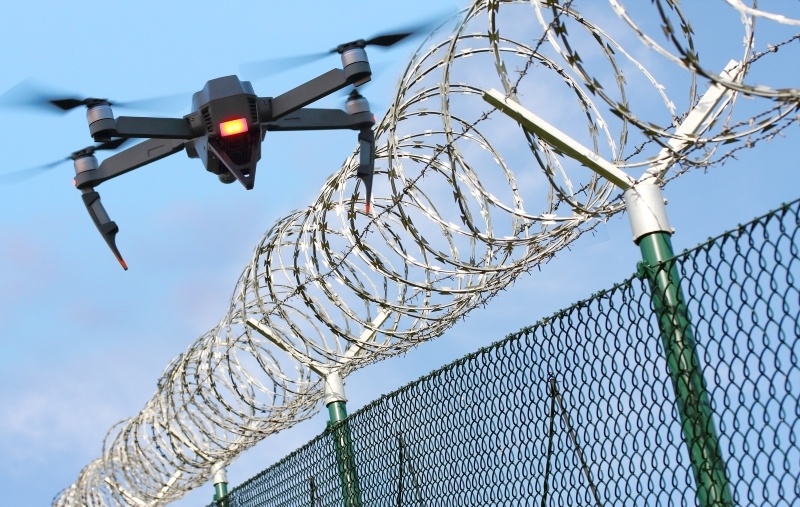
Defense One reports that FBI agents were monitoring a hostage situation involving organized crime at an undisclosed location last winter. To confuse the agents, the gang used a swarm of small drones to repeatedly fly close to their heads at high speeds, forcing them out of their hiding spot, according to the FBI’s head of operational technology, Joe Mazel, who spoke at the AUVSI Xponential conference on May 2nd. “We were then blind,” says Mazel — the agents, in other words, lost the target.
The criminals also livestreamed the drone’s footage on YouTube, showing their collaborators exactly where the agents were.
This is a pretty sophisticated use of drones, but it’s not the only way criminals are doing so. Drug smugglers have used drones to get contraband into prisons; other drones have helped immigrants illegally cross borders. Mexican drug cartels have even used drones to drop remotely-detonating explosives on targets.
Trend shouldn’t really come as a surprise. Drones are relatively cheap and powerful and, with a bit of practice, they can be flown by pretty much anybody. High fences, difficult terrain, and no-fly zones are just details to consumer drones, and their ranges are ever-increasing: even mainstream drones can now be operated from two to three miles away. A drone swarm takes a bit more doing, but it’s far from unfeasible.
But law enforcement isn’t sitting idly by while criminals are ratting out FBI agents in the field. In May 2017, the White House proposed that police should legally shoot down drones in response to the proliferation of small drones among criminals and regular drone enthusiasts alike — especially when they are being flown off-limits, like, say, over the White House.
And the Federal Aviation Administration is working to make it illegal to “weaponize” consumer drones, require drones to fly within the operator’s line of sight, and make a national registry of drones and their operators.
The FBI hostage situation is just one incident in a growing trend that has already become a real problem for law enforcement. Consumer technology is advancing faster than law enforcement can keep up. It’s a game of cat and mouse that, luckily, doesn’t seem to have led to much bloodshed, at least not yet. Regulating drones before that happens is probably not a bad idea.
The incident remains “law enforcement-sensitive,” Mazel said Wednesday, declining to say just where or when it took place. But it shows how criminal groups are using small drones for increasingly elaborate crimes.
Mazel said the suspects had backpacked the drones to the area in anticipation of the FBI’s arrival. Not only did they buzz the hostage rescue team, they also kept a continuous eye on the agents, feeding video to the group’s other members via YouTube. “They had people fly their own drones up and put the footage to YouTube so that the guys who had cellular access could go to the YouTube site and pull down the video,” he said.
Mazel said counter surveillance of law enforcement agents is the fastest-growing way that organized criminals are using drones.
Some criminal organizations have begun to use drones as part of witness intimidation schemes: they continuously surveil police departments and precincts in order to see “who is going in and out of the facility and who might be co-operating with police,” he said.
Drones are also playing a greater role in robberies and the like. Beyond the well-documented incidence of house break-ins, criminal crews are using them to observe bigger target facilities, spot security gaps, and determine patterns of life: where the security guards go and when.
In Australia, criminal groups have begun have used drones as part of elaborate smuggling schemes, Mazel said. The gangs will monitor port authority workers. If the workers get close to a shipping container that houses illegal substances or contraband, the gang will call in a fire, theft, or some other false alarm to draw off security forces.
Andrew Scharnweber, associate chief of U.S. Customs and Border Protection, described how criminal networks were using drones to watch Border Patrol officers, identify their gaps in coverage, and exploit them.
“In the Border Patrol, we have struggled with scouts, human scouts that come across the border. They’re stationed on various mountaintops near the border and they would scout … to spot law enforcement and radio down to their counterparts to go around us. That activity has effectively been replaced by drones,” said Scharnweber, who added that cartels are able to move small amounts of high-value narcotics across the border via drones with “little or no fear of arrest.”
Nefarious use of drones is likely to get worse before it gets better, according to several government officials who spoke on the panel. There is no easy or quick technological solution. While the U.S. military has effectively deployed drone-jamming equipment to the front lines in Syria and Iraq, most of these solutions are either unsuitable or have not been tested for use in American cities where they may interfere with cell phone signals and possibly the avionics of other aircraft, said Ahn Duong, the program executive officer at DHS’s homeland security, science and technology directorate.
The most recent version of theFAA reauthorization bill contains two amendments that could help the situation, according to Angela Stubblefield, the FAA’s deputy associate administrator in the office of security and hazardous materials safety. One would make it illegal to “weaponize” consumer drones.
The other — and arguably more important — amendment would require drones that fly beyond their operators’ line of sight to broadcast an identity allowing law enforcement to track and connect them to a real person.
“Remote identification is a huge piece” of cutting down on drone crime, Stubblefield said. “Both from a safety perspective… enabling both air traffic control and other UAS [unmanned areal systems] to know where another is and enabling beyond line-of-sight operations. It also has an extensive security benefit to it, which is to enable threat discrimination. Remote ID connected to registration would allow you to have information about each UAS, who owns it, operates it, and thus have some idea what its intent is,” said Stubblefield.
But even if both amendments pass as part of the re-authorization, it will be some time before they take effect, so it will be the Wild West in America’s skies a while longer


Discussion
0 CommentsShare your thoughts — every perspective adds value.