-
2022 Nissan Ariya: Contender or Pretender? | Car Deals
Posted:Thu, 27 May 2021 19:00:00 GMT
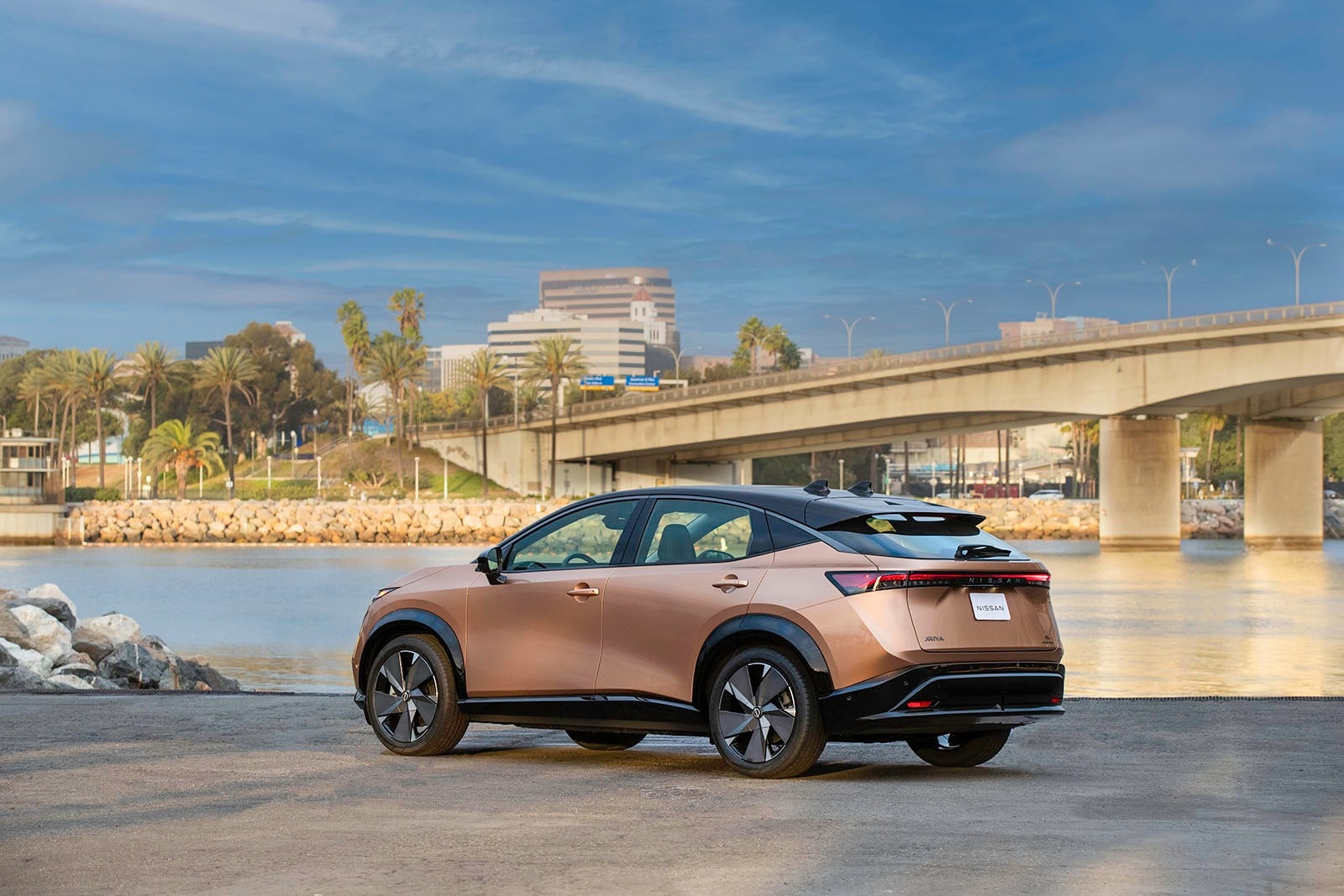
- Nissan is looking for a fresh start with the intriguing new Ariya
- Ariya promises a high-tech interior and the option of quick acceleration
- Does this Nissan have what it takes to compete against electric SUVs from Tesla, Ford and others?
Nissan already has the Leaf hatchback in its EV stable, but the automaker really needs an electric crossover to appeal to SUV-hungry buyers. Enter the 2022 Nissan Ariya, a crossover SUV with a compact footprint but lots of utility. Even though the automaker hasn’t said much since the Ariya’s reveal last summer, it’ll be here in just a few months’ time. Let’s take a look at Nissan’s new SUV and project whether it has the goods to hang with the Tesla Model Y, Ford Mustang Mach-E and other electric crossovers.
A new sense of urgency
Over the past couple of years, Nissan has really stepped up its game when it comes to interior design and materials quality, as evidenced by the Nissan Rogue‘s impressive redesign for 2021. The one remaining weakness shared by multiple Nissans is the continuously variable automatic transmission, or CVT — especially when it’s paired with a four-cylinder engine.
The all-electric Ariya has a major leg up on its stablemates because it will employ neither the CVT nor that four-cylinder engine, or any engine, for that matter. Freed of these burdens, the Ariya should prove to be relatively potent. The base model produces between 215 and 239 horsepower (depending on battery pack) and 221 lb-ft of torque — not phenomenal, but the output is higher than most Nissans, and the Ariya will benefit from the electric powertrain’s instant torque. Indeed, Nissan estimates the single-motor Ariya will accelerate from 0 to 62 mph in about 7.5 seconds, which is almost 2 seconds quicker than the Rogue.
But the all-wheel-drive version — which uses an electric motor at each axle — is the real winner here. The motors combine to produce 389 hp with the long-range battery (335 hp using the standard pack) and 443 lb-ft of torque, making the Ariya the first truly spicy Nissan SUV … ever? Nissan says the long-range AWD version can sprint to 62 mph in as little as 5.1 seconds, which would make it quicker than most versions of the Mustang Mach-E. The Model Y might beat the Ariya in a drag race, however.
Game-changing interior
The new Rogue and the redesigned 2022 Pathfinder show that Nissan is taking interior design seriously again. But like a lot of automakers, Nissan is employing a totally different cabin to distinguish its flagship EV from the rest of its lineup.
Step inside, and the first thing you might notice is the single panel that incorporates the twin 12.3-inch digital display screens. The center console is separated from the dashboard, which opens up the front of the cabin to give it an airier feel. The mouse-shaped shifter sits on this console, just ahead of the armrest and next to several drive mode controls that look like physical buttons but aren’t.
These controls, along with the climate controls on the dashboard, are distinct touch points on the wood trim. They offer haptic feedback when pressed, which Nissan says approximates the feel of mechanical switches. We’ll wait to make a definitive judgment in the Ariya’s case, but we’re not fans of these buttonless controls in other vehicles. Even with haptic feedback, it’s difficult — if not impossible — for a driver to distinguish between these segments of a flat panel without looking at them. Hopefully the voice recognition system will be able to make the necessary adjustments so drivers don’t have to take their eyes off the road.
From a size perspective, the Ariya is roughly the same length as the Rogue, though the EV’s wheelbase is 3 inches longer. That, combined with the totally flat floor, should give the Ariya’s rear passengers the opportunity to spread out a bit.
Tesla-beating range?
The jury’s still out on this one. Nissan says the Ariya will offer up to 300 miles of range, but it hasn’t been rated by the EPA just yet. The EPA has rated the Model Y, with the more conservative of the two trims estimated to travel 326 miles before running out of juice. That said, in Car Deals’ real-world EV range testing, we have generally found that Teslas underperform their EPA estimates, while other manufacturers’ EVs tend to go farther than what the EPA says. We’ll have a better idea of the Ariya’s capabilities once we get behind the wheel and subject it to our typical EV testing procedure.
Car Deals says
The 2022 Nissan Ariya’s quick acceleration, daring interior design and impressive projected range should give it the tools necessary to compete against top-tier electric SUVs. Stay tuned to our Ariya page for more details, including our driving impressions as soon as Nissan tosses us a key.
-
2020 BMW X5 xDrive40i Real-World Test: Decode the Mode | Car Deals
Posted:Thu, 27 May 2021 17:45:00 GMT
 To see what it’s like to live with a 2020 BMW X5 xDrive40i, we’ve put one in our long-term fleet, which means we’re running it for a full year and 20,000 miles. As the year progresses, our staffers fill up the logbook with comments on everything from road trips to reliability. Here’s the latest news on our long-term X5 xDrive40i.
The BMW X5 xDrive40i Lacks Agility
There is a stretch of Highway 1 between Monterey, California, and Los Angeles, that has a bespoke warning sign advertising 60 miles of hills and curves, which means it’s a great place to get a feel for a vehicle’s cornering capabilities. Josh Sadlier, our director of content strategy, put the X5’s capabilities to the test on this roadway on a recent trip to Monterey.
“In short, our nearly 5,000-pound X5 is a bit of a handful,” he says. “After much fiddling with the settings, I figured out that if I selected Sport Individual mode, put the steering in Comfort mode, the damping in Sport mode, the engine in Sport Plus and the transmission in Sport mode, the BMW X5 was serviceable through the twisty bits. But, only just.”
Even with the lightened-up steering, he notes you still feel all that mass sloshing about.
Leave the steering in Sport and the extra resistance merely magnifies the X5’s reluctance to change direction.
“I loved the X5’s heft on the freeway, but as a shopper, if I regularly drive on winding roads like Highway 1, I’d take a closer look at the smaller and presumably more agile X3,” Josh adds.
Additionally, our senior consumer advice editor, Ron Montoya, played around with some of the driving modes on his trip to Yosemite, California.
“A number of folks had commented that Sport mode was best on long drives,” he says. “I figured it was such a common thing that it would be left in Sport mode all the time.”
Ron didn’t realize he actually drove the five- to six-hour trip in Comfort mode, not Sport. “And, you know what? My passenger and I didn’t really notice anything horribly uncomfortable about it,” says Ron.
While Sport mode did tighten things up, he was fine leaving it in Comfort mode for the drive. Still, it’s worth test-driving this SUV for yourself to see if this is a deal-breaker for you or not.
2020 BMW X5 xDrive40i: Real-World Fuel Economy
After about eight months and over 10,000 miles driven, our overall fuel economy hovers around 19.9 mpg, which falls short of the EPA-estimated 22 mpg combined.
Average lifetime mpg: 19.9
EPA mpg rating: 22 combined (20 city/26 highway)
Best fill mpg: 23.2
Best range (miles): 435.2
Current odometer: 10,505Read more real-world fuel economy updates about our 2020 BMW X5 xDrive40i.
Car Deals says
We’re on the road all the time in our 2020 BMW X5, which means the logbook is brimming with our latest unvarnished opinions. Come along for the ride at our 2020 BMW X5 xDrive40i long-term test page.
-
Comfortable and Tech-Forward: We Drive the New 2022 Volkswagen Taos | Car Deals
Posted:Wed, 26 May 2021 13:00:00 GMT

- All-new two-row compact SUV to slot below Tiguan
- Turbocharged power and high fuel economy
- Sharp handling and comfortable interior
- Introduces the first generation of the Taos
What is the Volkswagen Taos?
The Taos is a brand-new vehicle for the U.S. market and Volkswagen’s smallest SUV. It promises confident handling in a package that is about 10 inches shorter than the brand’s next biggest SUV, the Tiguan. We expect the Taos will appeal to you if you’ve got an active lifestyle and want an SUV with more refinement than many other models in this price range.
The Taos is on the smaller end of the compact SUV category, competing with vehicles such as the Buick Encore GX, Jeep Compass, Mazda CX-30 and Subaru Crosstrek. The 2022 Volkswagen Taos will arrive at dealerships in the summer of 2021 and will start at about $23,000.
How does the Volkswagen Taos drive?
So far, we have been limited to about two hours of driving the Taos, but in that time a few things stood out. For one, the Taos seems to have the same polished ride and handling that VW’s big SUVs — the Atlas and Atlas Cross Sport — have. That’s great because we’ve been less impressed with the smaller Tiguan’s handling composure.
Power comes from a turbocharged 1.5-liter four-cylinder engine. It’s a new engine based on the 1.4-liter engine in the Jetta sedan. Volkswagen increased the muscle from 147 horsepower in the Jetta to 158 hp in the Taos. It generates its maximum 184 lb-ft of torque at a low 1,750 rpm, which helps you get to speed fairly quickly. On paper, the Taos’ engine falls below the 180-ish horsepower of its small SUV competitors, but in practice the Taos feels sufficiently peppy off the line.
Unfortunately, the automatic transmission doesn’t like to readily change gears. If you’re cruising along and step on the throttle, there is a puzzling lag in response as if the Taos says, “Hey buddy, are you sure you want to go full throttle?” Our theory is that VW tuned it this way to help out in the name of fuel economy. More on that below.
How comfortable is the Volkswagen Taos?
The Taos is very easy to drive. It stays composed around turns, and its steering is smooth and light. The ride quality is pleasant, too. The automatic engine stop-start system, which switches off the engine at stops to help save gas, activates quickly and with only a slight shudder. There’s an unwelcome amount of road and engine noise that infiltrates the cabin at speed, but this class of vehicle isn’t really known for being luxuriously quiet.
How’s the Volkswagen Taos’ interior?
The Taos brings Volkswagen’s philosophy of affordable refinement to the small SUV class. There are hard plastics, but VW has thrown in some nicer materials and even leather with contrast stitching. Many of the controls are soft to the touch. And we were pleased to see physical controls for the climate control, along with a tuning and volume knob of the stereo, which we prefer over having them relegated to a touchscreen, where they’re harder to use.
On higher trims, you can opt for a panoramic sunroof, which gives the cabin a more airy feel. Small SUV interiors have steadily become more premium, and it is nice to see the Taos continue that trend.
How’s the Volkswagen Taos’ tech?
It’s impressive from the moment you sit inside. All Taos models will come standard with a digital instrument cluster that can be customized to display anything from the song that’s playing to turn-by-turn directions, whether from the navigation system or from your phone, via Apple CarPlay or Android Auto. A 6.5-inch infotainment screen is standard, expanding at higher trim levels to an 8-inch screen capable of wireless connection for Apple CarPlay and Android Auto smartphone integration.
The Taos will also have optional safety packages that will include features such as blind-spot monitoring, rear cross-traffic alert and an adaptive cruise control that can bring the car to a complete stop when traffic gets backed up.
How’s the Taos’ storage?
Front-wheel-drive models of the Taos offer 27.9 cubic feet of storage with the rear seats up and 65.9 cubic feet with the seats down. The all-wheel-drive version cuts into the cargo capacity at 24.9 and 60.2 cubes, respectively. Even so, these are impressive numbers for a compact crossover SUV. For comparison, the rival Buick Encore GX offers 25.2 and 52.7 cubic feet. Honda’s CR-V and Volkswagen’s Tiguan are roomier, but the Taos likely has enough space for your typical stuff-hauling needs.
How economical is the Volkswagen Taos?
The Taos’ engine has several enhancements, including stop-start operation, that VW says helps improve fuel efficiency. Front-wheel-drive models of the Taos have an EPA estimated fuel economy of 31 mpg combined (28 city/36 highway). The all-wheel-drive Taos models drop to 28 mpg combined (25 city/32 highway).
This is better than many other similar SUVs, such as the Jeep Compass (25 mpg combined) and Mazda CX-30 (up to 28 mpg combined), and positions the Taos as one of the most fuel-efficient small non-hybrid SUVs available. However, we only have the EPA’s estimates to go on so far. We’ll know for sure once we get a Taos in for our own real-world fuel economy testing.
Car Deals says
Volkswagen has a compelling SUV on its hands. The Taos offers comparable sophistication and not much of a trade off in cargo space compared to its Tiguan stablemate, but at a lower price. The turbocharged engine is impressive, but we’ve yet to see if it can deliver on those lofty EPA numbers in the real world. We look forward to spending more time behind the wheel to get the full picture.
-
TESTED: 2021 Jeep Wrangler Unlimited Rubicon 392 – How Fast Is the Wrangler V8? | Car Deals
Posted:Tue, 25 May 2021 19:00:00 GMT

- Faster than it should be, the Hemi-powered Wrangler Rubicon 392 is exciting and terrifying all at once
- Sudden stops aren’t really its thing
- On-road handling that will put you in a ditch and off-road capability that will get you out of it
The idea of stuffing a V8 engine into a Jeep Wrangler isn’t a new one. In fact, it’s not even new from a factory equipment standpoint, as AMC, way back in 1972, stuffed its 304-cubic-inch V8 under the hood of a CJ-5 Renegade. And shade tree mechanics have been dropping one V8 or another in between the fenders of Jeeps since we don’t even know when.
But Jeep is friends with Dodge, and Dodge has these 392 Hemi engines just lying around and … yeah. It was only a matter of time before a snarling Stellantis 6.4-liter V8 wound up under a Wrangler’s hood, which brings us to the 2021 Jeep Wrangler Unlimited Rubicon 392. We knew it was going to be fast, but we didn’t think it was going to be quite so hilarious. And scary.
A rocket-propelled cinder block
We’ll start by saying that the four-door-only (hence the “Unlimited” part) Jeep Wrangler Rubicon 392 has a speed limiter at 100.5 mph. We know this because our Jeep 392 smacked right into said limiter in well under 13 seconds of full-throttle acceleration at our test track. And it rode that speed limiter right through the quarter-mile, which passes in 13.3 seconds. That’s not bad for a sport sedan, but this is a Jeep Wrangler.
Rewinding those 13.3 seconds, the Rubicon 392 nearly lifts its left front wheel in the air as it launches to 60 in 4.7 seconds (4.3 seconds if you use 1-foot of rollout like some other publications do). There’s no launch control in the Rubicon 392, so we power-braked it to about 3,300 rpm and let it rip. Is there wheelspin? Yes. Is it loud? Yes. And it’s fast enough that you could probably dust off that annoying Charger bro sitting next to you at the light. You know, the one with the yellow splitter guards.
You’ll stop. Just not now. Or now. Or now.
It’s a bit unfair to judge what is essentially a purpose-built off-roader by normal braking standards. But since you gotta drive it on-road to get somewhere off-road, it’s nice to know you can stop hard if you need to, which proved to be a challenge in our 392 Wrangler. The shortest distance we recorded during our panic stops from 60 mph was 143.6 feet. That’s long. That’s longer than a 7,000-pound-heavy-duty-pickup-truck long. We put the blame where the rubber meets the road. The BFGoodrich Baja Champion All-Terrain T/A KO2 tires just don’t have the grip to stop this Jeep quickly.
Braking stability isn’t so hot either. Again, that’s got something to do with the aggressive off-road nature of the tires, but the Jeep’s already vague steering and loose suspension make the Rubicon 392 feel like it’s wandering around all the way down to a stop. The brake pedal is another disappointment — it’s just too soft, with too much travel and no feel to speak of. This is a bit of a missed opportunity for Jeep since it could have probably fitted Hellcat brakes and charged another couple of grand without buyers batting an eye.
Moab? No problem. Mulholland? Not so much.
Again, the Rubicon 392 is essentially an off-roader first and an on-road vehicle fifth. Even with the improvements made to this newest JL generation, the Jeep’s steering is vague at best. When you put it on a skidpad, that steering and those aforementioned BFGoodrich KO2 tires conspire to do the bare minimum on asphalt. After much sawing at the wheel, we registered a scant 0.72 of lateral g on our skidpad. That’s a higher number than we recorded for the new Chevy Tahoe (0.70 g) and the Mercedes-Benz G-Class (a hilarious 0.62 g) but those vehicles were limited by overly cautious ESC (electronic stability control) that keeps things from getting too out of hand.
The 392 Wrangler, on the other hand, lets you turn everything off, which is cool until you punch the throttle and then remember that you can’t really stop hard and won’t have the grip to make the turn anyway. Even during our acceleration runs, the Jeep displayed a willingness to wander and weave with no steering input. Again, it might seem unfair to be critical of this Jeep for not handling well in an unnatural habitat, but this is 2021 and we do expect even a hard-core off-roader like the Rubicon to be less sloppy and spooky when you lean on it. Especially when you jam it with a 470-horsepower V8 engine.
Car Deals says
If you stick to what the Jeep Wrangler Unlimited Rubicon 392 does best, it’s a riot. Is it for everyone? Absolutely not. But it’s a unique and thrilling experience, especially with that ripping V8 soundtrack. If you can keep your right foot in check, at least until you get off the road, the Rubicon 392 will deliver more fun than you’ll know what to do with.
-
2022 Ford F-150 Lightning Is an Electric Truck With 563 Horsepower, Can Power Your House | Car Deals
Posted:Thu, 20 May 2021 01:30:00 GMT
- New electric version of the F-150
- Useful tech options, including the ability to use it as a battery for your home
- Independent rear suspension should improve ride quality
- F-150 Lightning Pro fleet variant offered for commercial customers
What is the F-150 Lightning?
As its name suggests, the Lightning is the all-new electric version of the F-150. But unlike some other upcoming splashy EV trucks such as the Rivian R1T, GMC Hummer EV and Tesla Cybertruck, the 2022 Ford F-150 Lightning is meant to be pretty normal. It looks a lot like a regular gas-powered F-150 and will have a similar starting price too: about $41,000. The truck will also qualify for the $7,500 federal tax credit, as well as other incentives provided by your state, city or power company.
“Game changer” might be an overused phrase these days, but an electric version of Ford’s most popular vehicle has the potential to introduce a new swath of customers to EVs and win over skeptics. We can’t think of a more appropriate description for this new electric F-150 that arrives at Ford dealerships nationwide starting in the spring of 2022.
What’s under the F-150 Lightning’s hood?
The Lightning starts its life as an F-150 SuperCrew (or crew cab) with a five-and-a-half foot bed. But instead of a gasoline engine and drivetrain, the Lightning has two electric motors and all-wheel drive. The Lightning will also come with a fully independent rear suspension, which should translate to improved handling and a more comfortable ride compared to the regular F-150’s traditional solid-axle rear suspension.
The standard battery pack and dual-motor setup produces 426 horsepower and a massive 775 lb-ft of torque — that’s more torque than any other F-150 currently on sale. For comparison, the F-150’s most powerful non-Raptor engine is the turbocharged V6 hybrid that makes 430 hp and 570 lb-ft.
Ford says the standard battery pack will deliver about 230 miles of range on a full charge. This is respectable for an EV, and especially something as big and heavy as an F-150. But this standard battery pack might be insufficient for you if you think you’d use your Lightning for frequent long trips or regular long-distance towing. We ourselves have demonstrated how towing a trailer can significantly decrease an EV’s range.
If that’s you, consider getting the F-150 Lightning’s extended-range battery. The larger battery not only provides an estimated 300 miles of range, but it also boosts the truck’s output to 563 hp (the 775 lb-ft stays the same). Ford says a Lightning with the big battery can accelerate from 0 to 60 mph in the mid-4-second range, which would make it quicker than the upcoming F-150 Raptor.
How’s the F-150 Lightning’s interior?
The Lightning’s interior is almost identical to that of the regular F-150 crew cab. In practical terms, you’ll get a spacious cabin that marries intuitively executed physical controls and an easy-to-use central touchscreen. Available features are also similar to what you’ll find in the standard F-150. These include the available fold-out center console table, front seats that recline nearly flat so you can stretch out and take a nap, and a lockable storage bin under the rear seat. One notable optional upgrade is a 15.5-inch vertically aligned touchscreen. This is the same one that’s in Ford’s Mustang Mach-E EV.
How’s the F-150 Lightning’s tech?
The Ford F-150 Lightning offers a number of clever technology features that are distinct from those in the standard F-150. Ford’s upcoming hands-free driving system, BlueCruise, will be available on the Lightning. It works on more than 100,000 miles of premapped divided highways to take the stress out of long-haul driving by taking control of the truck’s steering, acceleration and braking. While it is a hands-free system, BlueCruise uses cameras to monitor the driver to make sure the person’s in the pilot’s seat and paying attention.
Like both the Mustang Mach-E and F-150, the Lightning can receive over-the-air updates through its infotainment system. These updates (Power-Ups, in Ford speak) can give your truck the latest software and features without having to visit a dealership. The Lightning will also let you use your smartphone as the truck’s key so that you don’t need to use a separate key fob.
How do I charge the F-150 Lightning?
If you opt for the extended-range battery pack, Ford will provide a robust home charging station (Ford Charge Station Pro) for free. Installation will be at your expense, but this is quite a nice perk for new EV owners since most popular home charging stations cost hundreds of dollars for the unit alone and generally aren’t as powerful.
The Lightning can gain up to 30 miles of driving range per hour using the Ford Charge Station Pro. But even if you don’t get Ford’s charger, you should consider a dedicated charging station or 240-volt outlet a necessity for the F-150 Lightning. Attempting to charge using a household-style 120-volt outlet will be impractical because it would take too long to recharge.
The Lightning also supports DC fast charging for quick top-offs while on the road. Plugging into a 150-kW station can charge the battery from 15% to 80% in about 40 minutes, Ford says.
This electric F-150 will also offer a few special features you don’t commonly see on EVs. First up is the ability to power your home with electricity in the event of a power outage. If you’ve got your truck connected to Ford’s charging station and a power inverter, the Lightning can provide up to 9.6 kW worth of constant electricity. With a fully charged battery, Ford says it’s possible that you could use the Lighting to power your home for a few days or even longer if you ration the power.
The Lightning will also offer the F-150’s existing Pro Power Onboard feature, which consists of household-style electrical plugs in the bed, cab and front trunk that you can use to power tools and other electronic devices (delivering as much as 9.6 kW combined). Finally, Ford says it’s working on a feature that can use the truck’s battery to power the home during high-cost peak-energy hours and then charge the truck during off-hours, helping to save money on your home electric bill.
How’s the F-150 Lightning’s towing and hauling?
Because hauling, and more significantly towing, can have a significant impact on range, the F-150 Lightning’s two battery packs offer different peak capabilities. A Lightning with the standard-range battery has a max payload capacity of 2,000 pounds. Ford hasn’t said what payload capacity will be with the presumably heavier extended-range battery pack, but it does say that version of the truck will provide up to 10,000 pounds of towing capacity when equipped with the Max Trailer Tow package.
In addition to bed and in-cabin storage, the F-150 Lightning joins other EVs in opening up the space under the hood for extra cargo capacity. The power front trunk, or frunk, provides around 14 cubic feet of space and, per Ford, can fit two sets of golf clubs. Along with four power outlets and two USB ports, the frunk is water-resistant and even features drain plugs.
Like the Mustang Mach-E, the F-150 Lightning adjusts its range projections based not only on route, traffic and topography but usage as well. For instance, the Onboard Scales tech that debuted in the F-150 — where the truck uses its sensors to approximate payload — adjusts estimated range based on payload weight. It does the same when you tow, by sensing the tongue load. And when you tell it the size of the trailer, it figures out the air resistance and factors that into the range estimate as well.
What are the F-150 Lightning’s trim levels?
The Lightning is available in fewer trim levels than the standard F-150. The base model, which starts at $39,974 (destination not included), is followed by the XLT ($52,974, before destination), Lariat and Platinum.
Ford hasn’t yet disclosed the features for the base trim level, but it’s configured more like a commercial or fleet trim level. The base model can also be optioned with the extended-range battery. Commercial buyers who select the Lightning Pro fleet variant can expect essentially the same specs and capabilities as the regular base Lightning to start with, along with easy-to-clean vinyl seats. The SYNC 4 infotainment system with a 12-inch touchscreen is also standard.
Most shoppers will land in the upper trim levels. Topped out, with all the options and additions such as the new 15.5-inch center touchscreen, the Lightning should reach close to $90,000. For comparison, a fully loaded 2021 F-150 Platinum crew cab with the hybrid powertrain will set you back around $78,000.
Car Deals says
The Ford F-150 EV is officially called the Lightning, and with up to 563 horsepower, we can’t think of a more appropriate name. Even if you don’t opt for the big-battery version and all the neat upgrades, the Lightning has all the tech features and practical considerations to make this electric F-150 a success. Check back with Car Deals in the coming months as we’ll continue to add Lightning coverage about features, driving performance, range and more.
-
2021 Acura TLX Type S First Drive | Car Deals
Posted:Thu, 20 May 2021 13:00:00 GMT
- The TLX is redesigned for 2021
- Acura’s Type S performance trim, last seen in 2008, is back
- The TLX Type S has 355-hp V6 and standard all-wheel drive
Acura is definitively jumping back into the sport sedan business with the 2021 TLX Type S. The current selection of fast four doors such as the Audi S4, BMW 3 Series (M340i) and Genesis G70 (3.3T) have all evolved to such high levels of potency, Acura really needed to spice things up to make it back onto anyone’s menu. A full redesign of the TLX for the 2021 model year allowed it to lay the groundwork to relaunch its Type S performance branding that was last seen more than a decade ago.
The Type S returns
The last time you could buy a new Acura with a Type S badge on it was 2008. This was the TLX’s forebear, the old wedge-shaped TL that the Car Deals editors at the time heaped a good amount of praise upon.
Even the base TLX looks sporty and has the underlying suspension bits to bring about athletic handling. The new car is also longer, lower and wider than its predecessor. Yet Acura also knew from the outset that it was going to bring back the Type S version.
The easiest way to spot a Type S out of a sea of TLXs would be from its quad exhaust pipes and 20-inch wheels or the Type S-exclusive Tiger Eye Pearl paint, which is a spectacular shade of metallic mustard.
There’s some value here too. With an MSRP ranging from $53,325 to $54,125, which includes destination, the TLX Type S is a compelling pick for a performance-oriented small luxury sedan. Expect it at Acura dealerships in late June 2021.
New V6, newfound power
Powering the TLX Type S is a new turbocharged 3.0-liter V6 engine that makes 355 horsepower and 354 lb-ft of torque. These aren’t segment-topping figures, but they are a significant upgrade from the standard TLX’s turbo four-cylinder’s 272 hp and 280 lb-ft of torque. For comparison, the similar-in-approach Audi S4 makes 349 hp and 369 lb-ft of torque. An all-wheel-drive system (Acura calls it SH-AWD) and a 10-speed automatic transmission come standard.
The V6 features a single, quick-spooling turbocharger that develops maximum torque from a low 1,400 rpm, providing a wave of ample and linear thrust almost immediately off idle all the way to 5,000 rpm. Acura estimates that the Type S can cover 0-60 mph in about 5 seconds, which feels accurate from the driver’s seat.
Care about fuel efficiency? The Type S gets an EPA-estimated 21 mpg in combined city/highway driving. For context, on the high end, the BMW M340i xDrive returns an impressive 25 mpg combined, while the Genesis G70 is on the lower end at 20 mpg combined.
Enjoyable speed and handling
The TLX Type S comes with five drive modes settings (Comfort, Normal, Sport, Sport+ and a customizable Individual mode). Each mode alters the engine and transmission characteristics, steering effort, suspension damping, all-wheel-drive tuning and even exhaust sound to suit your driving intentions. Put the car in its Sport+ and it is pretty much ready for all-out driving with firmer suspension damping and sharper steering responsiveness.
We had a chance to really test the Type S at its upper limits on a closed race course, and it delivered fun and confident speed. The car’s additional frame bracing really helps make the car feel solid and responsive. The quicker ratio steering, which almost felt too quick out on the street, feels perfect in this setting, and the standard Brembo brakes deliver powerful stopping power without much pedal effort.
The all-wheel-drive system, which has the ability to send up to 70% of available torque to either of the rear wheels, can essentially force the TLX on an unnaturally tight arc by channeling extra power to the outside rear tire. That allows for harder and earlier acceleration out of turns, as you can feel the extra power going to the outside rear wheel, helping to enhance traction and give the Type S a more balanced and nimble feel. It feels a little like cheating, but, oh boy, is it effective.
Those who crave the challenge of driving a performance car with a more aggressive personality might find the Type S too stable, easy and predictable. But out on real roads where there are higher consequences and more variables in play, the built-in safety nets on the Type S feel welcome and kind of make it an optimal tool for drivers at any experience level.
Still comfortable and luxurious
Dial things back to Normal or Comfort mode and the Type S transforms into a comfy luxury cruiser. The adaptive suspension does a nice job of absorbing road impacts. The Comfort setting, in fact, even felt a little too soft on some roads with more rolling undulations, which made the TLX feel like a boat out at sea. But chances are there’s a setting that will work for nearly any scenario, which makes the Type S a versatile vehicle that’s easy to live with.
Seat comfort is a high point as well. The front seat cushions are soft yet supportive and very adjustable, even offering variable lateral and lumbar support to better hold you in place during spirited driving. The rear seats are also pretty cushy, though they don’t offer nearly as much support as the front seats.
Another trick up Acura’s sleeve is the way the TLX deals with noise and vibration. Active noise cancellation and active vibration control utilize the vehicle’s speakers and electronically controlled mass dampers to actively cancel out noises and vibrations from the engine and road. The Type S engine also has the ability to deactivate half of its engine cylinders to save fuel but that usually causes a natural imbalance, adding noise and vibration. These systems can counteract those imbalances as well. Overall, the TLX is impressively quiet for a small luxury sedan.
Upgraded interior, sorta improved tech
Acura’s new generation of interiors are a serious step up. While it isn’t a complete reinvention of the look and feel of an Acura interior, the quality and design are elevated appropriately for the small luxury sedan class. There are also a handful of Type S-specific details in the interior, including embossed headrest logos and simulated suede seat inserts.
Front seat space is excellent and will be comfortable for a wide range of adults. But while the TLX has grown in overall length, overall passenger volume remains nearly unchanged. This is still a small luxury sedan, and the back seat is where it’s most noticeable. Passengers taller than 5 foot 10 or so will start to feel cramped.
Also, Acura’s touchpad-based infotainment system is a polarizing feature and takes some getting used to. That’s especially the case if you consistently switch between the native infotainment interface system and a smartphone integration system such as Apple CarPlay and Android Auto. The 10.2-inch display screen is well sized, crisp and attractive, but we can’t help but think that Acura could improve the overall interface by making the screen a touchscreen.
Car Deals says
The 2021 Acura TLX Type S is a highly compelling performance sedan that seems to have just the right blend of speed and luxury. It’ll provide driving thrills but also a decent amount of technology, convenience and daily comfort. There’s a ton of value at its asking price compared to what the European marques typically charge, though the Genesis G70 still comes in slightly lower. Ultimately, we think this is one of the strongest offerings Acura has made in any sedan segment for quite some time, and it has the potential to be a class favorite.
-
TESTED: 2021 Porsche 718 Cayman GT4 | Car Deals
Posted:Wed, 19 May 2021 19:00:00 GMT
- For having “only” 414 horsepower, the 718 Cayman GT4 sure is quick
- This is the best-handling sports car on sale today
- It might be tough to justify its price, until you drive one
When Porsche takes one of its already capable sports cars and sets out to build a more focused version of it, you know it’s going to be good. The 2021 Porsche 718 Cayman GT4, which we will refer to as the GT4 from here on out, takes the basic 718 Cayman and adds a bucketload of performance goodies: a special suspension, a lower ride height, larger brakes, a fixed rear wing, ultra-sticky summer tires and a mechanical limited-slip differential. Oh, and there’s the 4.0-liter flat-six engine tuned to make 414 horsepower and rev to 8,000 rpm. Yeah, the GT4 is a good thing.
Looks fast, sounds fast, is fast
It is wonderful that Porsche offers the GT4 with a six-speed manual transmission as standard equipment. But if you want to go as fast as possible, Porsche’s PDK dual-clutch automatic is the way to go. Summoning the GT4’s launch control (just put the transmission into Sport and disable stability control) sends the Porsche off the line with a 6,000-rpm clutch drop and on to 60 mph in just 3.8 seconds (3.6 seconds with 1 foot of rollout like the magazines use). Keep your foot in it and the GT4 howls through the quarter-mile in just 12 seconds at just over 115 mph.
It’s definitely worth mentioning that the GT4 has this speed with “only” 414 horsepower. Most sports cars need another 100 horsepower to match these numbers, and none sounds as glorious as the Porsche. If we could change one thing, and it really is only one thing, we’d give the GT4 shorter gearing to better match the high-revving nature of the engine and its relatively narrow powerband. We’d still buy one anyway.
So this is what perfect feels like
Setting aside the GT4’s staggering 1.14 g on the skidpad, if we can, let’s talk about just how good the GT4 is to drive. There was a time, probably before you were old enough to drive, where you imagined what it would be like to drive a sports car. You imagined the car reacting to your every move, seemingly devoid of limits and giving you the confidence to go faster through every corner. Well, that’s what driving the GT4 feels like.
It possesses an amazing balance, and thanks to nearly telepathic steering, the GT4 can go anywhere you’re precise enough to put it. At its considerable limits (remember that 1.14 g figure from the skidpad) there’s mild understeer, but experienced drivers can will the GT4 to do just about anything they please. Yes, we’re gushing. Yes, it’s that good.
Car Deals says
More than one of our editors declared the GT4 to be the best sports car they’ve ever driven. And that feeling isn’t just the result of cold, hard numbers. Instead, it’s the combination of the sound from the 4.0-liter flat-six, the responsiveness of the chassis, and the car’s ability to do whatever you want all day long. Yeah, it’s a lot of money. And yeah, you can buy cars with more speed and power for less, but you’ll have a very hard time finding a car that simply feels as good to drive as the GT4.
-
The 2022 Genesis G70 Gets a New Look and New Features | Car Deals
Posted:Tue, 18 May 2021 16:00:00 GMT
- New front and rear styling
- Updated dashboard design and bigger infotainment screen
- Launch Edition limited to 500 vehicles
- Part of the first G70 generation introduced for 2019
What is the G70?
Being a relatively new luxury brand like Genesis has its advantages and its drawbacks. One drawback is simply breaking in against the established brands. Buyers can be hesitant to try something new; once you buy a BMW, Mercedes-Benz or Audi, you might not want to stray. But a new brand doesn’t have a design heritage to follow and nothing is written in stone. With its new generation of vehicles, and specifically the G70, Genesis is making full use of its advantages to minimize its drawbacks.
For 2022, the G70, which is the brand’s smallest and sportiest luxury sedan, gets a rather comprehensive restyling to follow in the footsteps of its striking brandmates, the G80 and G90 sedans and the GV80 SUV. And changes aren’t just limited to the exterior. The G70’s interior gets a welcome refresh to include a new 10.25-inch infotainment screen and more premium materials. And if you’re into limited editions, there’s a G70 Launch Edition with available red leather seats and two choices of matte paint. Already a solid luxury sport sedan, the 2022 G70 could be just the thing if you’re bored with the traditional luxury brands.
What’s under the G70’s hood?
The 2022 G70’s two available engines are unchanged from last year, and either one will likely meet your needs. The base engine is a turbocharged 2.0-liter four-cylinder engine that makes a respectable 252 horsepower and 260 lb-ft of torque. And if you’d like more power, and to unlock the full sport sedan experience, there’s a twin-turbocharged 3.3-liter V6 engine that cranks out 365 hp and 376 lb-ft. The V6’s power is similar to what you can expect from the impressive BMW M340i and the Mercedes-Benz AMG C 43 and far more than you get from a Lexus IS 350. Both engines run through an eight-speed automatic transmission and can be had in rear- or all-wheel drive.
How does the G70 drive?
I’ve driven the G70 with the V6 in both rear- and all-wheel-drive configurations and can definitively say that you’re in for a lot of fun however many wheels you want driving your G70. The V6 is a powerhouse, producing prodigious torque without having to work very hard. It makes driving around town and merging onto highways an absolute breeze. And if you like to carry a little more speed, the V6 is happy to oblige. It’s got gobs of power at high rpm, and when you select the new Sport+ drive mode, the transmission will let the engine run all the way to redline before shifting and downshifts smartly into lower gears under braking.
The G70 is a playful sport sedan. When equipped with the V6 engine, it’s actually pretty easy to make it powerslide its tail out when you’re going around a turn. This is true even if you get it with all-wheel drive — the system’s torque vectoring and available limited-slip differential ensure lively handling in all conditions. Oh, and there’s even a drift mode for the more adventurous.
However, I still think the G70’s chassis could use a bit more refinement. Driving on rougher roads produces occasional flutters and shimmies through the car and, believe it or not, I’d prefer the G70 to be a little more controlled and less willing to powerslide out of every corner. Thankfully, the G70 does communicate its intentions clearly, so you know when you’re going to have to be on your toes. Above all else, it’s engaging, and I like that.
How comfortable is the G70?
The G70’s ride quality is generally smooth, and thanks to the electronically adjustable suspension dampers, it can be comfortable for daily driving and then more taut and controlled for more enthusiastic driving. The front seats are comfortable and supportive. The top-trim G70 I drove sported heating and ventilated seats, and the rest of the climate controls were easy to use and relatively quiet, even when exterior temperatures exceeded 100 degrees.
As you’d expect from a luxury sedan, the G70’s interior is well isolated from the outside world. But when you stomp your foot down, the V6 engine comes through without being grating, and the newly available variable exhaust system adds a little extra growl.
How’s the G70’s interior?
In both appearance and feel, the G70 exudes quality and attention to detail. It feels every bit as well built as its rivals. A new, partially digital instrument cluster greets the driver while the equally new 10.25-inch infotainment touchscreen looks right at home in the modern interior. More of the dash is now covered with simulated leather upholstery. In the higher trim levels, perforated leather seats with contrasting stitching add to the G70’s premium look and feel. The rest of the controls are straightforward. It’s refreshing to see a luxury brand not intent on redesigning every control just to be different.
In regards to space, the front seat passengers will enjoy ample room and adjustability from the seats. Passengers more than 6 feet tall will find themselves a bit short on rear legroom, however. The rear seats do offer above-average support but are best suited for smaller passengers.
How’s the G70’s tech?
The most obvious change to the G70’s in-car tech is the new central 10.25-inch touchscreen. It’s a big improvement over the previous unit, which looked too downmarket and tacked on. The new unit features an attractive widescreen format and good usability thanks to crisp-looking graphics and a simple menu structure. It’s also better integrated into the dashboard and looks much less tacked on than the one in last year’s G70.
Apple CarPlay and Android Auto smartphone integration is standard, as is navigation. Genesis has also included new features such as more natural voice recognition; the ability to use the surround-view camera system to provide a snapshot of the area surrounding your parked G70 while you’re away; and over-the-air updates to give you the latest infotainment software without having to go to the dealer. There’s even an available digital key in both a NFC (near-field communication) card and an Android-based app, the latter being shareable across multiple phones. This feature ensures you’re much less likely to ever be locked out of your vehicle or even need the physical key at all.
On the advanced driver aids front, the G70’s new features include a highway driving assist, which uses lane centering and adaptive cruise control to take the edge off longer highway drives, collision avoidance for rear cross-traffic and blind spots, and navigation-based cruise control capable of automatically slowing your car down for upcoming curves.
How economical is the G70?
Fuel economy hasn’t been a strong suit of the G70. While the 2.0-liter four-cylinder does get an estimated 24 mpg in combined city/highway driving, it trails the Audi A4 (up to 28 mpg combined) and BMW 330i (up to 30 mpg) by a substantial margin. It’s more of the same for the more powerful 3.3-liter V6. With all-wheel drive, the V6 G70 is rated at only 20 mpg combined compared to the BMW M340i xDrive’s 25 mpg.
Car Deals says
From its performance to its premium features and excellent value for money, there’s always been a lot to like about the G70. The updated 2022 G70, with its more distinctive styling and enhanced technology features, is an even more compelling pick for a small luxury sport sedan.
-
TESTED: 2021 Ford Mustang Mach 1 | Car Deals
Posted:Thu, 13 May 2021 19:00:00 GMT
- The 2021 Mustang Mach 1 is a Greatest Hits of the current-generation Mustang
- The 480-horsepower V8 has some of the best-sounding horses around, and we even like the 10-speed automatic
- The Mach 1 is one of the hardest-stopping cars we’ve ever tested and one of the best-handling too
The Ford Mustang Mach 1 doesn’t surface very often (we last saw it in 2004), but when it does, it brings an attractive mix of features and performance. It’s no secret that the current-generation Mustang is nearly at the end of its run, so what better way to send it off than with a combination of the best parts? The 2021 Mustang Mach 1 has engine modifications that we saw in the Bullitt, suspension bits from the GT350 and GT500, huge tires with tons of grip, and a unique exhaust system.
But all that doesn’t mean much if it doesn’t come together at the test track. So how did the latest Mustang Mach 1 perform when we tested it? Let’s find out.
You’re not gonna break the sound barrier, but it’s fast
It’s always safe to assume that a 480-horsepower Mustang is going to be fast. But when it’s bolted up to Ford’s 10-speed automatic, the new Mach 1 is eyebrow-raisingly fast. At our test track, the Mach 1 knocked off 60 mph in 4.1 seconds (3.8 seconds if you use 1 foot of rollout, which some other publications do) and pulverized the quarter-mile in 12.5 seconds at 113.1 mph. And with every shift happening at 7,500 rpm, it sounded absolutely glorious along the way. The unique exhaust tips of the Mach 1 produce a slightly higher-pitched note than the standard GT. Everyone in attendance made sure to stop and listen to every pass.
But with a Tremec six-speed manual as standard equipment (the same unit that was used in the GT350), why would we bother with the 10-speed automatic? Well, that’s a tough call. The six-speed features trick rev-matching software and is one of the best manual gearboxes on sale today, but the 10-speed automatic is no slouch. Having tested plenty of six-speed Mustangs, we can say the 10-speed is undeniably quicker getting to 60, but it’s also adept at aggressive track driving as well as just cruising around. Call it a win-win for everyone.
Stops with the best of them. Turns pretty good, too.
Let’s get the tires out of the way first. When equipped with the handling package, the Mach 1 comes shod with Michelin Sport Cup 2s — the ultra high-performance tire these days — in 305-section front and 315 in the rear. That’s a lot of rubber. But it still blew us away to see the Mach 1 stop from 60 in a scarcely believable 93.8 feet. That’s one of the shortest distances we’ve ever measured and shorter than some of the best European exotica you care to name. It’s not just the sticky tires that have us so impressed. The Mach 1’s brakes feature unique ABS tuning and the pedal feels absolutely spot-on, with minimal travel and plenty of feel.
Those tires give it some otherworldly grip around the skidpad too. We clocked a 1.10 g average around our 30-meter skidpad and found the Mach 1’s balance to be exceptional. We’d love more feel from the steering, especially just off of center, but the Mach 1 remains a very friendly beast, right up to and even beyond its considerable limits. Did Ford really build a user-friendly 480-hp Mustang? Yes, yes, it did.
Car Deals says
We’d understand if you felt a little jaded about the 2021 Ford Mustang Mach 1. It has all the hallmarks of a corporate cash grab — the vintage badge, a special sticker pack and the fact that the current generation is nearing the end of its run. But the Mach 1 is genuinely impressive. Motivation from the 5.0-liter V8 was never in doubt, but the combination of various Shelby suspension and aerodynamic bits as well as a superbly balanced chassis make this the Mustang to get for 2021.
-
The Hyundai Palisade Is Flying Off Dealer Lots, and Here’s Why | Car Deals
Posted:Wed, 12 May 2021 19:00:00 GMT
- Through the first four months of 2021, the average Hyundai Palisade spent just 25 days at the dealership before selling
- The average three-row midsize SUV sits for 48 days before finding a buyer
- The Palisade is winning because it’s a great product — the Car Deals experts currently rank it No. 2 in this very competitive segment
Hyundai has been searching for a three-row winner for a long time.
Sales of the Veracruz floundered until it was discontinued in 2012. Hyundai fared better with the Santa Fe through 2018 (briefly renamed Santa Fe XL for 2019), but it didn’t break any new ground.
That has changed with the Hyundai Palisade, which enters its second year of production for 2021. New data shows that Hyundai’s fresh family hauler is resonating with buyers in a big way.
“This is arguably Hyundai’s most important vehicle,” said Ivan Drury, senior manager of insights at Car Deals.
Compared to rivals, the Palisade is flying off dealer lots. The average Palisade sold in just 25 days through the first four months of 2021, while other three-row SUVs averaged 48 days. Among direct competitors, only the Kia Telluride moved faster.
Buyers also shouldn’t count on incentives. While other three-row SUVs have averaged a 4.3% discount so far in 2021, the Palisade is averaging a discount of just 0.4%.
Notably, the Palisade’s most expensive trim, the Calligraphy, accounts for a hefty 23% of all 2021 Palisade sales. The average transaction price of the Palisade Calligraphy is just shy of $50,000.
What’s driving Palisade sales?
For Jan Afrasiabi, a billing specialist in Fayetteville, Georgia, the Palisade was a surprise fit.
Afrasiabi wanted to trade in her leased Hyundai Santa Fe for something bigger. She didn’t know Hyundai had a vehicle that large, and assumed she would buy a Toyota Highlander. But when she arrived to trade the Santa Fe, she saw the Palisade. It looked just right.
“It had similar room inside, but wasn’t big and clunky on the outside,” Afrasiabi said. “Plus, the price was right.”
Palisade sales are drawing business away from competing brands at a higher rate than other Hyundais, according to Drury. But it is also playing a crucial role in keeping current customers, like Afrasiabi, within the family.
Afrasiabi bought a Palisade SE, the entry-level model. Still, she’s impressed by the level of comfort and the array of tech features inside — particularly, as the mother of a young child, its rear-occupant alert system, which notifies the driver if the second row is still occupied upon leaving the vehicle.
Customers are beginning to feel a kinship with one another too, Afrasiabi said.
“Now I wave to other Palisades when I see them. And they wave back!”
Car Deals ranks Palisade no. 2 behind Telluride
Judging by its performance in Car Deals’ rigorous vehicle testing, the Palisade deserves its newfound popularity. We rank it second among three-row midsize SUVs as of this writing, behind only the Telluride.
The Palisade’s overall rating of 8.2 out of 10 included a score of 8.5 in four key categories for a midsize SUV: Comfort, Interior, Storage and Value. We were also impressed when we put the Palisade through our dynamic evaluation at the track, noting that the standard V6 engine has “a smooth surge all the way to [redline]” and “sounds good, too,” while the brake pedal “has a nice mix of responsiveness and travel and gives nothing but confidence.”
Car Deals says
The sales data surrounding recent Hyundai Palisade purchases shows that it’s resonating with today’s buyers. In the process, Hyundai is drawing customers away from rivals such as Honda and Toyota without having to attach incentives to the deal. We think the Palisade is a winner for buyers, and that’s proving true for Hyundai so far too.
-
2020 BMW X5 xDrive40i Real-World Test: Versatile Powertrain Outshines Patchy Smartphone Connectivity | Car Deals
Posted:Wed, 12 May 2021 19:00:00 GMT
To see what it’s like to live with a 2020 BMW X5 xDrive40i, we’ve put one in our long-term fleet, which means we’re running it for a full year and 20,000 miles. As the year progresses, our staffers fill up the logbook with comments on everything from road trips to reliability. Here’s the latest news on our long-term X5 xDrive40i.
The BMW X5 xDrive40i’s Versatile Powertrain Makes it Zippy for Daily Use
Like we do with every vehicle we get our hands on, we tested our 2020 BMW X5 xDrive40i at our private test track. The X5 recorded a 5.0-second 0-60 mph sprint and completed the quarter-mile in 13.9 seconds. All in all that is pretty good, especially when you want to feel like you are actually moving when you step on the gas.
Even without the V8 engine, the inline-six in our long-term X5 is plenty quick. Passing power is ample and fuel economy is still pretty alright. We were even impressed by the ECO PRO mode, especially in stop-and-go traffic. This is a versatile powertrain, and we would be hard-pressed to explain why the V8 is better for day-to-day use.
Read more real-world performance updates about our 2020 BMW X5 xDrive40i.
Our 2020 BMW X5’s Smartphone Integration Is a Bit Lackluster
The 2020 BMW X5 comes with additional standard highlights that include Bluetooth connectivity and Apple CarPlay and Android Auto smartphone integration.
However, vehicle test editor Kurt Niebuhr was not impressed with the X5’s Android Auto setup.
First thing? It takes a solid minute or more to load after starting up the car before your music picks up where it left off. Twice Kurt shut off his phone’s Bluetooth and WiFi connection because he thought the connection had gotten hung up.
Second, the connection gets choppy. Like, music-skipping choppy, and that’s pretty frustrating. It might be the age of “my antiquated Pixel, but still. I’d just prefer a wired connection,” Kurt added.
He did like how the map and music selection fills the wide-format screen. Some manufacturers will leave a blank space where the music information is displayed or just throw up the Android Auto logo — that’s low-effort.
Read more real-world technology updates about our 2020 BMW X5 xDrive40i.
2020 BMW X5 xDrive40i: Real-World Fuel Economy
After about eight months and over 9,000 miles driven, our overall hovers around 19.9 mpg, which falls short of the EPA-estimated 22 mpg.
Average lifetime mpg: 19.9
EPA mpg rating: 22 combined (20 city / 26 highway)
Best fill mpg: 23.2
Best range (miles): 435.2
Current odometer: 9,317Read more real-world fuel economy updates about our 2020 BMW X5 xDrive40i.
Car Deals says
We’re on the road all the time in our 2020 BMW X5, which means the logbook is brimming with our latest unvarnished opinions. Come along for the ride at our 2020 BMW X5 xDrive40i long-term test page.
-
Top Cash Offers and No-Interest Loans for May 2021 | Car Deals
Posted:Wed, 12 May 2021 19:00:00 GMT
We’re focusing on deals on widely available 2021 models in the month of May, but we’re just scratching the surface. Inventories are running low these days due to a semiconductor chip shortage. If you’re in need of a car, our experts recommend shopping sooner rather than later. Head to our car deals home page to find all the currently available incentives, or check out our $199 lease deals roundup for this month’s most affordable lease offers.
Remember that not everyone will qualify for every offer and not all offers are available in every state. Contact your local dealer to find out more.
2021 Buick Enclave
Buick is offering $5,700 in customer cash on the 2021 Enclave. It’s a well-rounded three-row SUV with plenty of power and space. The Enclave is worth a look if you fancy a quiet and comfortable ride that’s easy to wheel around town. Read more about the 2021 Enclave
See Enclave models for sale near you
See all Buick incentives in your area2021 Chevrolet Bolt EV
Chevrolet is offering $9,000 in customer cash on the 2021 Bolt EV. The Chevrolet Bolt is a solid electric vehicle, especially with its 259 miles of range. It solves many of the qualms that people have traditionally held about buying an EV. A spacious interior and fun-to-drive dynamics are bonuses. Read more about the 2021 Bolt EV
See Bolt EV models for sale near you
See all Chevrolet incentives in your area2021 Dodge Charger
Chrysler is offering 0% APR for up to 72 months, plus up to $4,000 in customer cash, on some trims of the 2021 Dodge Charger. This large sedan distinguishes itself from the pack with a combination of performance, comfort and muscle-car styling. Acceleration is quick, and the brakes are reassuringly strong. Read more about the 2021 Charger
See Charger models for sale near you
See all Dodge incentives in your area2021 Genesis G70
Genesis is offering 0% APR for up to 72 months on the G70. This small sport sedan captures some of the performance-based magic historically associated with the BMW 3 Series. The tight back seat keeps it from being a good pick for a family car, but the G70 remains a strong choice for an entry-level luxury car. Read more about the 2021 G70
See Genesis G70 models for sale near you
See all Genesis incentives in your area2021 Honda Accord
Honda is offering 1.9% APR for up to 60 months on the Accord. The Accord is our No. 2 ranked midsize sedan. It’s an undeniably compelling package, and it’s enjoyable to drive. Some rival sedans might best the Accord in a few areas, but no other sedan puts it all together as well as this one. Read more about the 2021 Accord
See Accord models for sale near you
See all Honda incentives in your area2021 Hyundai Elantra
Hyundai is offering 0% APR for up to 60 months or up to $3,000 in customer cash on the compact Elantra sedan. The redesigned Elantra stands out with its high fuel economy, impressive technology and safety features, and roomy cabin. It’s also comfortable and strong on value. Read more about the 2021 Elantra
See Elantra models for sale near you
See all Hyundai incentives in your area2021 Hyundai Kona
Hyundai is offering 0% APR for up to 60 months or up to $3,000 in customer cash on the Kona. The Hyundai Kona is one of our favorite extra-small SUVs. It has an easy-to-use infotainment interface, smooth-operating driving aids and quick acceleration from its optional turbocharged engine. It’s also pretty fun to drive thanks to its nimble handling and small size. Read more about the 2021 Kona
See Kona models for sale near you
See all Hyundai incentives in your area2021 Jeep Cherokee
Jeep is offering 0% APR for up to 72 months or up to $750 in customer cash on the compact Cherokee. The latest Jeep Cherokee ditches its nontraditional styling for a more familial Grand Cherokee Light design. The V6 is still an option, and there’s a hot turbocharged 2.0-liter engine as well. In proper Jeep fashion, the Cherokee remains one of the most capable compact SUVs in the segment. Read more about the 2021 Cherokee
See Cherokee models for sale near you
See all Jeep incentives in your area2021 Kia K5
Kia is offering 0% APR for up to 60 months on the top-rated K5 sedan. The Kia K5 has the style and substance to set it apart from other midsize family sedans. It’s incredibly easy to drive and comfortable on longer trips thanks to a great suspension and an exceptionally quiet cabin. Read more about the 2021 Kia K5
See K5 models for sale near you
See all Kia incentives in your area2021 Mazda CX-30
Mazda is offering 0.0% APR for up to 60 months on the subcompact CX-30 SUV. The top ranked CX-30 is a sophisticated and sporty entry into the extra-small SUV class. It has striking looks and plenty of standard features. Read more about the 2021 Mazda CX-30
See CX-30 models for sale near you
See all Mazda incentives in your area2021 Ram 1500
Ram is offering a cash allowance of up to $4,500 on some versions of the Ram 1500, one of Car Deals’ top-rated trucks. The Ram 1500’s coil-spring rear suspension is a unique feature in the segment, giving it a smooth ride without compromising hauling or towing capacity. Read more about the 2021 Ram 1500
See Ram 1500 models for sale near you
See all Ram incentives in your area2021 Toyota Corolla
Toyota is offering 0% APR for up to 60 months or up to $1,500 in customer cash on the 2021 Corolla. The Toyota Corolla is a smart pick in the small sedan class. We give it high marks for its smooth ride, high-quality interior, and comprehensive list of advanced safety features. Read more about the 2021 Corolla
See Corolla models for sale near you
See all Toyota incentives in your area -
2021 Jeep Wrangler 4xe Plug-In Hybrid Gets Optional Lift Kit and More | Car Deals
Posted:Wed, 05 May 2021 19:00:00 GMT
- A 2-inch lift kit is now available for the plug-in hybrid Wrangler 4xe, because of course it is
- The kit will cost $1,495 and include Fox shocks, new springs and various other suspension upgrades
- Other Mopar options include a Jeep wall charger and more conventional mods like rock rails and a Warn winch
Just because the 2021 Jeep Wrangler 4xe is a plug-in hybrid shouldn’t mean it’s any less of a Jeep. But until recently, the 4xe lacked some key enhancements from the brand’s extensive options catalog. Happily, the Wrangler 4xe can now be equipped with a 2-inch lift kit, so if you want to take those extra electrons into the wilderness, you’ll be able to do so with even greater ease. And although the lift kit is the headline item, there are a number of new options for the Wrangler 4xe that should please shoppers who prefer to enhance their plug-in Jeep with factory upgrades.
All the gear you need to get higher — and charge faster
In case you’re not familiar, the Wrangler 4xe plug-in hybrid pairs a 2.0-liter turbocharged four-cylinder engine with two electric motors and a 17-kWh battery pack, a combination that yields an EPA-estimated 21 miles of all-electric range before shifting to gasoline consumption. That’s pretty cool, but the hybrid powertrain also changes the vehicle’s weight distribution, so Jeep had to develop some specific parts for the 4xe’s lift kit. Fork over the $1,495 asking price and you’ll get a customized wood crate full of goodies from Jeep Performance Parts, including four Fox shocks, four springs, front lower control arms, front and rear stabilizer links, front and rear bump stops, and various fasteners.
For at-home charging, Jeep is also offering Jeep-branded 240-volt wall chargers. They come in two variants: hardwired ($621.50) and plug-in ($647.90). Jeep claims they’ll charge your Wrangler 4xe at five times the rate of a standard cordset cable.
Otherwise, the 4xe gets pretty much all the customization options you’d expect from a Wrangler, including rock rails ($925), tube doors ($1,195), a winch-compatible front bumper ($1,275), a Warn winch ($1,595), an off-road LED light kit ($725) and much more.
Car Deals says
If you want to customize a vehicle with parts directly from the manufacturer, the Jeep Wrangler was already one of the best vehicles for the job. But now that the plug-in Wrangler 4xe is essentially as customizable as any other Wrangler, with unique all-electric drivability to boot, you’ve got some interesting new ways to build an ultra-capable Jeep.
-
Mercedes Finally Has a Tesla Competitor With the 2022 Mercedes-Benz EQS | Car Deals
Posted:Mon, 03 May 2021 19:00:00 GMT
- The EQS luxury sedan is Mercedes’ first electric vehicle that’s designed to tackle Tesla head-on
- From the dashboard-spanning Hyperscreen infotainment setup to the illuminated seats, the EQS brings some stunning features to the table
- Mercedes projects a driving range of up to 478 miles per charge, but that’s per Euro-standard WLTP testing, which tends to be more optimistic than EPA testing
The gold standard meets electric motors in the 2022 Mercedes-Benz EQS luxury sedan. It has taken a full decade for the brand most synonymous with luxury to join the fight for EV supremacy, but the wait looks to have been worth it. As you’d expect from Mercedes, the cabin technology is cutting-edge, while the interior appointments look lush enough to make many a Tesla Model S shopper think twice. Just don’t expect Tesla-topping acceleration yet — that’s a job for the upcoming AMG performance variant.
What took you so long?
A lot has happened, to put it mildly, since Tesla supercharged the EV scene by releasing the Model S sedan in 2012. But luxury automakers have only recently begun to respond with serious shots over Tesla’s bow. That allowed the Model S to sit virtually unopposed in the electric executive sedan space for years. Things are starting to change, however. Porsche launched the Taycan sedan in 2020, and Audi is poised to join the fray later this year with the closely related e-tron GT. The latest member of the “better late than never” club is the 2022 EQS, which looks to trump them all with its emphasis on modern luxury over outright driving performance.
Putting the “luxury” in luxury electric car
The Model S was always kind of a hard sell as a luxury sedan. Yeah, it has a six-figure price tag, and its performance is unimpeachable. But take a step inside its cabin, and you might be underwhelmed. The layout is minimalist to an extreme, with few adornments to accompany the central touchscreen and digital instrument panel. With the exception of the air suspension, HEPA filters and 22-speaker audio system, there aren’t many features here that you couldn’t also find in many modern automobiles.
The EQS is a different beast entirely. Its name suggests it’s an electrified version of the recently redesigned S-Class sedan, and while that technically isn’t the case — the EQS is closer to an E-Class in exterior size — the two vehicles share a similarly styled interior and some features. Both sport a line of exotic trim and upholstery options, use ambient lighting strips extensively throughout the cabin, and feature rear-axle steering that points the rear wheels the opposite way at low speeds to reduce the turning circle. The two models also offer some nifty upgrades in common, including deeper personalization options with the MBUX infotainment system and a head-up display that can virtually project navigation instructions onto the lanes you need to enter.
It’s at this point that the EQS takes a hard left turn from normalcy. While the S-Class uses a low-mounted tablet touchscreen, the EQS says “hold my beer” and makes the entire dashboard one massive screen. The Hyperscreen, as it’s called, spans the width of the vehicle. It incorporates three screens — a digital instrument panel, a typical central screen, and another touchscreen in front of the passenger.
The Hyperscreen drives home the impression that Mercedes isn’t taking this EV lightly. Rather, the automaker is looking to make a splash, underscored by goodies including remote door opening and closing, illuminated seat surrounds, backlit trim elements, and several engineered audio tracks that play while the vehicle is accelerating to compensate for the lack of traditional engine hum. Mercedes knows luxury like perhaps no other brand, and it looks like the EQS will leverage this knowledge to separate itself from other upscale EVs.
The EQS will be faster than the Model S, right?
Hold your horses, slick. Mercedes’ new luxe EV starts in the EQS 450+ trim. A single motor powers the rear wheels and develops 329 horsepower and 406 lb-ft of torque. The EQS 580 4Matic is the all-wheel-drive version, and it puts out a that’s-more-like-it 516 hp and 611 lb-ft. Mercedes says the EQS 450+ will cover 0-60 mph in 5.5 seconds, while the EQS 580 cuts that to 4.1 seconds.
Great stuff, but Tesla says the Model S can make the same run in less than 2 seconds. Although we’ve found that Tesla tends to quote optimistic acceleration times, Car Deals’ most recently tested 2020 Model S Performance sprinted to 60 mph in less than 3 seconds. Buyers looking for the ultimate electric luxury sedan from a performance standpoint might have to wait until the rumored AMG version of the EQS launches. We hear Mercedes is targeting more than 600 horsepower, which it will need to break that 3-second barrier.
What about driving range per charge?
Sadly, an apples-to-apples range comparison between the EQS and Model S won’t happen for a little while. The current Model S Performance (the only 2021 Model S to be rated by the EPA as of this writing) delivers up to 387 miles of driving range per EPA estimates, while Tesla says the Long Range version, due later this year, will offer 412 miles of range. The biggest news is the Plaid+ version, for which Tesla projects north of 520 miles of range when it is released in mid-2022.
As for the 2022 Mercedes-Benz EQS, it hasn’t been rated by the EPA yet, though it does carry a range estimate of up to 478 miles per the European WLTP testing standard. Historically, WLTP ratings have been considerably more optimistic than EPA ratings, though some of Car Deals’ own real-world range results have ended up closer to WLTP estimates than to those published by the EPA. In short, there’s no clear answer on EQS range at this juncture, but we look forward to testing the EQS on our driving loop as soon as Mercedes can make one available.
Car Deals says
It took nearly a decade, but Mercedes-Benz is finally entering the executive EV sedan market. The upcoming EQS is seemingly loaded with more luxury and tech features than any vehicle this side of a Rolls-Royce. It could end up being the truest vision yet of a luxury electric car. Just press pause on that plan to challenge a Model S at the drag strip.
-
Big SUV Shootout: 2021 Chevy Tahoe vs. 2021 Ford Expedition | Car Deals
Posted:Fri, 30 Apr 2021 16:00:00 GMT
- Goliath vs. Goliath results in a near tie
- Expedition offers higher tow ratings and more horsepower
- Tahoe provides smoother ride and newer tech
The 2021 Chevrolet Tahoe and 2021 Ford Expedition are the biggest, baddest and most capable full-size family/toy haulers you can get. The Tahoe (and longer-wheelbase Suburban) was redesigned for this year, now featuring a wide selection of engines and newer technology features. The current-generation Expedition (and its longer Expedition Max variant) has been on sale for longer but has received regular improvements over the years.
Both SUVs offer comprehensive family-friendly features, expansive interior space and plenty of giddyup. To determine why you might choose one over the other, we brought in an example of each for a full evaluation and comparison.
Engines and fuel economy
The Ford Expedition is only available with one engine — a turbocharged 3.5-liter V6 — but with two power levels. Most trim levels have 375 horsepower; the top-of-the-line Platinum offers 400 hp.
The Chevrolet Tahoe engine choices include two V8s (a 5.3-liter and 6.2-liter) and a turbodiesel six-cylinder, but there are limitations on availability. The 420-hp 6.2-liter is only available on the top-of-the-line trim level, and you also can’t get the turbodiesel with the Z71 off-road trim level. Most Tahoes use the 5.3-liter V8, which makes 355 hp. Both the Tahoe and the Expedition use 10-speed automatic transmissions.
The Expedition’s power advantage is obvious when you slam the gas pedal, but its extra grunt also shows up at lower speeds, like on residential or city streets, making it slightly more pleasing to drive. Conversely, the Tahoe’s V8 soundtrack is a joy, even if it’s lacking in power.
Regardless of configuration, the Ford Expedition gets an EPA-estimated 19 mpg combined, and Chevy’s 5.3-liter V8 gets 18 mpg combined. In our experience, it’s harder to match the EPA’s numbers with the Expedition. Your mileage will vary, but the takeaway is that 1 mpg is not that big of a difference here. If you seek the ultimate in fuel economy, Chevy’s turbodiesel offers up to 24 mpg combined.
Winner: Ford
Suspension and comfort
Both the Expedition and Tahoe have available adaptive suspension dampers on most trim levels, but the Chevy goes one step further by also offering air springs on its Z71 and High Country variants. When equipped with this suspension combination, the Tahoe rides far more smoothly than the top-trim Expedition, with added stability that makes it easier to keep within its lane. The Chevy’s air suspension can also lift the suspension for better ground clearance and lower it for easier access and improved aerodynamics.
The Tahoe’s ride pairs well with the seats. Though they can feel too firm at first, the seats offer fatigue-free driving over long distances. The Expedition has softer front seats that make a more plush first impression, and they seem to absorb some of the bumps from the busier ride. Both SUVs offer heated and ventilated seats, but the Expedition goes one step further with available front seat massage. Alas, Ford’s massage function and the seat ventilation systems in both SUVs are unpleasantly loud.
Winner: Chevy
Phone connectivity, technology and driver aids
The most recently updated of the two, the Chevy Tahoe features more sophisticated technology features. It comes with a larger center screen on all trim levels (10.2 inches versus the Ford’s 8-inch screen used on most trim levels) that’s nicer to look at, and it’s available with wireless Android Auto and Apple CarPlay, as well as wireless charging.
Though not as impressive initially as the Chevy, the Expedition’s center screen remains highly functional and supports modern phone integration needs — so long as it’s wired.
While both SUVs are available with exterior camera systems, the Tahoe’s is the more comprehensive of the two, offering multiple views that help in a variety of situations. You have traditional forward, aft and top-down views, but you also get side angles that show the front wheels relative to painted parking lines or curbs. The tow package also includes a camera angle to help align a trailer hitch.
Winner: Chevy
Interior space, storage and towing
The Chevy Tahoe has a bit more cargo space per row than the Expedition, and its third-row folds down more quickly too. For its part, the Ford Expedition features a clever folding storage system that can switch between a two-shelf tray or a barrier, so items don’t fall out when you open the rear hatch.
Both SUVs have exemplary seating space for all three rows. Differences are minor, like how the Tahoe’s second row has a touch less headroom when it’s equipped with the sunroof or the additional comfort afforded by the Expediton’s available power-reclining third row.
The Tahoe’s power-sliding center console and its secret agent-style hidden compartments are neat but seem fussy. And don’t get us started on the Tahoe’s shifter either. It uses a combination of buttons and levers to change gears and adds needless anxiety to three-point turns on busy roads.
As always, towing figures vary by configuration and options, and both of these SUVs offer a tow package that increases their capabilities. A 4WD Expedition with its tow package has a 9,200-pound tow rating, while an equivalent Tahoe with the 5.3-liter V8 has an 8,200-pound rating.
Winner: Ford
Car Deals says
Both of these large SUVs have considerable strengths and only small downsides. While the Expedition receives our overall recommendation, the difference is close enough that we could see buyers choosing one over the other depending on their needs.
The 2021 Tahoe offers broader engine availability (including a diesel), newer tech appointments, more cargo volume and a nicer ride. On the other hand, the Expedition’s simplicity, both in regard to available configurations and interior functionality, is attractive, as are its stronger and smoother engine and higher max tow figure.
To see more about these SUVs and others like them, visit our SUV rankings page.
-
The 2021 Ford F-150 Can Measure the Weight of Your Payload | Car Deals
Posted:Wed, 28 Apr 2021 23:00:00 GMT
- Starting with midyear production, the 2021 F-150 will be able to estimate the weight of your payload and your lard-butt passengers
- An additional new feature measures a trailer’s tongue weight
- New adaptive suspension dampers are also available
So, you’ve got a pickup truck and you’re going to load some heavy things into the bed. You know, things like lumber, tools and that overpriced barbell set you bought off Craigslist at the start of the pandemic and never really used. But how much weight can you safely put back there without exceeding your truck’s maximum payload rating?
Normally, you’d have to estimate the weight of the load or, failing that, tell yourself, “Ehh, I’m sure it’s fine” as you watch your truck’s rear suspension sag toward the ground.
But you won’t have to guess at all if you buy a 2021 Ford F-150.
The 2021 F-150, of course, is the fully redesigned one, sporting new features such as a hybrid powertrain and a robust onboard generator. But Ford says that 2021 F-150s hitting dealer lots starting in late summer 2021 will come with two additional optional features to help you haul and tow: Onboard Scales and Smart Hitch.
Measuring the F-150’s payload weight
This new Onboard Scales feature estimates the weight of stuff you’ve put in the F-150’s cargo bed and displays it with a graphic on the touchscreen in real time. Checking the touchscreen might not be super convenient if you’re outside the truck and loading things in the bed, so Onboard Scales also provides a visual representation of payload by illuminating progressive sections of the taillights. Ford says Onboard Scales info will also be available through the FordPass smartphone app.
We reached out to Ford for further clarification and learned that the system knows the truck’s maximum payload rating based on its configuration (e.g., crew cab, 3.5-liter V6, 4WD, etc). From there, it has sensors at all four corners of the truck to monitor the weight being added.
This is key because maximum payload rating is derived from the truck’s gross vehicle weight rating (GVWR) minus its curb weight. Curb weight is the truck plus anything else you’ve put in it. You might assume payload capacity just means what you can put in the bed. But additional passengers and gear inside the cab also count toward a truck’s payload capacity. Onboard Scales measures both.
There’s also a taring function to zero out the payload reading. For example, you could check available payload with passengers in the truck, zero out, and then further measure the weight of new payload items you’re adding to the bed.
The F-150 can check your trailer’s tongue weight too
Trailer tongue weight is how much of your trailer’s weight can be distributed onto the towing vehicle through the tow hitch. Having a proper weight is crucial for safe towing and helps minimize trailer swaying or overloading the rear suspension and tires.
Normally, calculating your trailer’s tongue weight requires towing your trailer to a scale, weighing the tow vehicle with and without the trailer, and subtracting those two measurements. Smart Hitch saves you from that hassle by calculating the tongue weight as soon as you hitch up the trailer. As with Onboard Scales, the information can be accessed by touchscreen, smartphone app or by the truck’s taillights. The system also provides guidance on weight distribution so you can balance your trailer to get a proper tongue weight.
New adaptive suspension dampers
As if that weren’t enough, these midyear 2021 Ford F-150s will also be available with an adaptive suspension system. It automatically adjusts the suspension dampers to enhance the truck’s ride comfort and handling. The driver can further tune the system by selecting one of the truck’s driving modes. In the Tow/Haul mode, Ford calibrated the suspension to provide a smoother and more precise towing experience.
This is the first time the regular F-150 has been available with adaptive dampers. Ford is late to the party, however — the latest Chevrolet Silverado and GMC Sierra offer adaptive dampers and the Ram 1500 offers an adjustable air-spring suspension.
Car Deals says
We like how Ford continues to come up with new features that make using a truck even easier. Onboard Scales and Smart Hitch look to be like two valuable add-ons to get on an F-150 if you’re planning on doing a lot of hauling and towing. For more information, check out our full review of the 2021 F-150.
-
TESTED: The 2021 Dodge Durango SRT Hellcat Is a Seriously Fast SUV | Car Deals
Posted:Wed, 28 Apr 2021 22:00:00 GMT
- In Car Deals’ track testing, the Durango Hellcat proved quicker than much pricier rivals like the Maserati Levante Trofeo and BMW Alpina XB7
- The 5,567-pound SUV did 0-60 in a blistering 3.9 seconds at our test track
- With 710 horsepower and 645 lb-ft of torque, the Durango SRT Hellcat is the most powerful factory-built SUV on sale today
Dodge’s supercharged 6.2-liter V8 has been making its way into seemingly every vehicle in the Dodge/Jeep/Ram family, but the Durango three-row family hauler remained untouched — until now. The 2021 Dodge Durango SRT Hellcat is here, and family road trips will never be the same.
In addition to the V8’s utterly bonkers power and torque, the Durango Hellcat gets plenty of other upgrades, including more powerful brakes, an upgraded suspension and more aggressive styling. But how would it all come together at the Car Deals test track? We were pretty stoked to find out.
What makes the Durango Hellcat so fast?
The engine is obviously the Durango Hellcat’s crown jewel, but there are a few other things SRT engineers changed to improve performance. Along with the Jeep Grand Cherokee Trackhawk and Ram 1500 TRX, the Durango is one of three Hellcat-powered vehicles to use all-wheel drive. That helps the Durango Hellcat put all 710 horsepower to the road better than rear-drive Hellcats such as the 797-horsepower Dodge Challenger Hellcat Redeye.
Power is fed through a slick-shifting eight-speed automatic transmission, and wheel-mounted paddle shifters are standard. Other upgrades include Brembo brakes and performance tires to improve grip and shorten braking distances. Adjustable drive modes allow the Durango’s suspension to be compliant or firm and sporty, depending on driver preference.
Well, how did it perform?
It should come as no surprise that the Durango SRT Hellcat is one of the quickest SUVs we’ve ever tested despite tipping our scales at 5,567 pounds, the equivalent of about two Honda Civics. Using launch control to get the best possible start, the Durango Hellcat blasted from zero to 60 mph in just 3.9 seconds, flying through the quarter-mile in 12.1 seconds at 113.1 mph. To use launch control, you press the “Launch” button on the center console, stand on the brake with your left foot, then nail the gas and release the brake. The Hellcat makes so much torque that it will start creeping as soon as you apply the throttle, so you really have to push the brake with all your might to get a good launch.
It’s not just quick either. Brembo brakes and 295/45 ZR20 Pirelli P Zero tires at all four corners help stop the Durango from 60 mph in just 111 feet. That’s shorter than cars including the Ford Mustang Bullitt, BMW i8 and Jaguar F-Type. Lateral grip on the skidpad was the Durango’s weakest area, which is no surprise given just how big and heavy it is. Still, 0.91g is a respectable number.
Car Deals says
Emissions and fuel economy standards will eventually spell doom for unfettered beasts like the Durango Hellcat. But until then, why not Hellcat all of the things? It certainly makes for a more interesting three-row family SUV. Check out our Durango page for a full assessment of the Durango lineup for 2021.
-
PRICED: 2022 Volkswagen Taos Starts at $24,190 With 31 MPG | Car Deals
Posted:Wed, 28 Apr 2021 21:00:00 GMT
- The pint-sized Taos starts at $24,190 including destination fees
- EPA-rated fuel economy tops out at 31 mpg combined for front-wheel-drive models
We expected the upcoming 2022 Volkswagen Taos to have a tough road ahead of it. After all, there are plenty of competent subcompact SUVs on the market. Why should shoppers look to the Taos instead of the Honda HR-V, Subaru Crosstrek or our top-rated Mazda CX-30?
Well, Volkswagen just gave us more to go on by releasing pricing and fuel economy information. In sum, the Taos seems a bit pricey at first blush, but it’s pretty frugal if you don’t need all-wheel drive.
Specifically, the 2022 Taos will arrive this summer with a base price of just over $24,000 including fees. And if you stick with the standard front-wheel-drive layout, you’ll get an EPA-estimated 31 mpg combined (28 city/36 highway), although the AWD version drops to 28 mpg combined (25 city/32 highway).
How the 2022 VW Taos stacks up
The Taos’ fuel economy ratings instantly place it near the top of the class, at least with front-wheel drive. Few subcompact crossovers offer a combined EPA rating of 30 mpg or more, so for shoppers who don’t need AWD, the Taos will have an edge at the pump.
We have yet to evaluate a Taos at the Car Deals test track, but we did take a brief spin in a Taos prototype last year. Our first impression was that the turbocharged 1.5-liter four-cylinder engine felt tuned for efficiency — it delivered adequate power, but it lacked initial throttle response when called upon. However, the Taos was otherwise crisp and refined on the road. If it can replicate its EPA rating in the real world, it may have a shot at tackling the Kona, Buick Encore GX and Mazda CX-30 at the top of our X-Small SUV rankings.
Priced right, too?
The pricing story is a bit more complicated. By the numbers, the base Taos S model starts at $24,190 including destination, while adding all-wheel drive bumps the bottom line to $26,235. The midlevel Taos SE costs $28,440 to start and the top-level Taos SEL is priced from $32,685. All prices include destination.
This is pricey for the class. Many extra-small SUVs start around $20,000. Our top-rated Mazda CX-30 is right at $23,000 including destination, while the Hyundai Kona is cheaper still. The Subaru Crosstrek includes all-wheel drive as standard for $23,295.
To be fair, the Taos will come standard with appealing features including alloy wheels, LED lighting and a 6.5-inch touchscreen, so its higher price may just mean it comes with more stuff right out of the box. We’ll reserve judgment until we get one in for testing.
Car Deals says
Impressive fuel economy ratings are a step in the right direction for the Taos, and we’re intrigued by its promise of a smooth ride and upscale interior. Stay tuned to our official Taos page for all the latest from Car Deals’ vehicle testing team.
-
2021 Porsche Taycan Cross Turismo: Wagon-ification Is Cool | Car Deals
Posted:Tue, 27 Apr 2021 22:10:00 GMT
- A Porsche Taycan with more cargo space and extra ground clearance
- Standard dual-motor, all-wheel-drive powertrain
- Sporty driving dynamics that don’t compromise on comfort
- Part of the first Taycan generation introduced for 2020
What is the Taycan Cross Turismo?
The Porsche Taycan Cross Turismo is a different flavor of Porsche’s first-ever electric vehicle, the Taycan. Like the Porsche Panamera sedan’s Sport Turismo variant, the Taycan Cross Turismo has a wagon-like profile that provides additional cargo space and a slightly roomier rear passenger compartment compared to its more traditionally styled sibling. But the Taycan Cross Turismo goes even further, adding nearly an inch of ground clearance for better performance on rough roads. This isn’t going to be a rock crawler, but it should be able to navigate dirt roads on the way to a country cottage.
Of course, that would ideally be a country cottage with a charging station. The Taycan Cross Turismo, like the regular Taycan, is fully electric. Ride height aside, the Cross Turismo drives and performs similarly to the regular Taycan sedan, though one with some added ability if your route is unpaved. That’s a good thing since the Taycan is one of the best-driving cars on the market today, electric or not. And as with the Taycan, don’t be surprised if the real-world all-electric range is much better than what the EPA estimates. In our testing, the Taycan sedan far exceeded its estimated range.
What’s powering the Taycan Cross Turismo?
All variations of the 2021 Cross Turismo are all-wheel-drive and have electric motors at the front and rear axles. A battery pack sits under the floor and can be recharged at a public charging station or at home. Horsepower ratings mirror those of the regular Taycan. That means there’s choice of the 375-horsepower Taycan 4 Cross Turismo, the 482-hp 4S model, the 616-hp Turbo and the top-level Turbo S. All versions offer additional power when the launch control function is activated. For example, the Turbo S is capable of 750 hp in short bursts when you use launch control.
Just like the all-wheel-drive Taycan sedan, the rear-axle motor uses a two-speed transmission for increased efficiency at highway speeds. Powering those motors is the 93.4-kWh battery pack from the Performance Battery Plus option on the Taycan sedan, which is standard on the Taycan Cross Turismo.
How does the Taycan Cross Turismo drive?
Getting into the Taycan Cross Turismo feels a lot like getting into the regular Taycan sedan. But the cabin seems a bit more spacious, with the rear window now farther away from you, and far less steeply raked. That effect is enhanced by the rear window profiles, which follow the Cross Turismo’s longer roofline, changing the over-the-shoulder view out from the driving seat.
Crunching the numbers underlines that the Cross Turismo loses some of its accelerative ability and outright top-speed potential to its Taycan relation, but, where directly comparable, the Cross Turismo drops only 0.1 second in the 0-60 mph sprint and a few mph off the top speed. The quickest, the Turbo S, rips from 0 to 60 mph in just 2.7 seconds, according to Porsche.
Where it gains back is its ability to drive off-road. The Cross Turismo rides 0.78 of an inch higher than the regular Taycan, and you can further boost the ride height by using the Gravel mode, which is specific to the Cross Turismo. When engaged, it raises the standard air suspension by an additional 0.4 inch and applies different settings to the stability, traction and suspension systems. Still, the Cross Turismo’s off-roading capability is best suited for unpaved roads or gentle trails.
The Cross Turismo is heavier than its Taycan relation, but that doesn’t manifest itself on the road — the electric powertrain’s instant torque makes light work of its mass, and the same is true dynamically. The Taycan has always impressed with its agility and ability to cover ground, and the Cross Turismo loses none of that — it’s hugely quick and capable, and rides very well too. Analyzed in detail, the Cross Turismo isn’t quite as pin-sharp to turn into bends as the Taycan sedan. But for the additional ability it brings it’s well worth that insignificant trade-off.
How comfortable is the Taycan Cross Turismo?
The Taycan Cross Turismo is more comfortable than the standard Taycan, particularly in the rear, where there is 3.6 inches of additional headroom, which is transformational if you’re likely to be carrying rear passengers. That’s not just because they have greater room above their heads, but also because the longer and higher door glass makes getting in and out of the rear seats far easier.
With all trims featuring an air suspension, the Taycan Cross Turismo manages to mix fine body control with good ride comfort. That’s true even on the highest performance models, with the largest wheel and tires fitted. The way the suspension smooths out poor surfaces is very impressive, while the absence of sound, unless you activate it via the sound generator, makes for serene progress. Wind and road noises are all kept at bay, too. All of it adds up to excellent comfort for the driver and passengers.
Depending on the model, the Taycan Cross Turismo comes with a choice of eight- or 14-way power-adjustable and heated seats with memory functions or 18-way power-adjustable, heated seats with memory. (The latter is standard on the Turbo S and optional on other models.) The rear seat configuration is available in either two- or three-seat format. Getting three adults in the back would be a tight fit, but three children will squeeze in, though we doubt the one in the middle would be too happy on anything more than a short drive.
How’s the Taycan Cross Turismo’s interior?
Get into the driver’s seat and ahead of you is a 16.8-inch curved digital instrument panel, with two screens in the center stack that split infotainment and climate control duties. It all works well with a bit of familiarity, though at times some conventional switches or dials would make some functions a little bit less fiddly. That’s particularly true when it comes to the heating and ventilation controls.
As with all Porsches, there are a myriad of customization options to help buyers create a bespoke vehicle, not least here, given its environmental focus, the choice of an interior free of leather. The fit and finish is exceptional throughout, as are the materials used. The cabin feels airy thanks to that longer roofline and more expansive glasshouse, and it evokes a feeling that’s rich in tech, but not overwhelmingly so. It feels every bit the high-dollar premium car inside, as it should given its price, but even the top models have expansive and expensive opportunities to add equipment. To wit, our test Taycan Cross Turismo Turbo S added over $30,000 of options to the $180,000 price.
How’s the Taycan Cross Turismo’s tech?
An electric car for the brave new world, it’s hardly surprising that there’s a lot of technology in the Taycan Cross Turismo. Every one comes standard with an adaptive air suspension with smart lift, which uses GPS to remember where you’ve used it previously to negotiate tricky driveways, speed humps or curbs. All Cross Turismos also come with Apple CarPlay smartphone integration, a smartphone compartment with inductive charging, and four USB-C charge points throughout the interior (two in the front, and two in the rear).
Optionally you can add everything from conveniences such as a head-up display to a night vision camera system, surround-view parking cameras or high-end Burmester 3D surround-sound stereo.
How’s the Taycan Cross Turismo’s storage?
The Cross Turismo maintains the Taycan’s front trunk’s 2.9 cubic feet of cargo capacity but expands the rear storage space. Up from 14.3 cubic feet in the Taycan and Taycan 4S, the 4 and 4S Cross Turismo offer 15.8 cubes behind the rear seats or 42.8 cubes with the seats down.
Just like the sedan, the Turbo and Turbo S offer less cargo space than the non-Turbo models but still offer 14.3 cubes, or 41.3 cubes with the seats folded. While that’s not as much capacity as, say, the Panamera Sport Turismo, it gives the Cross Turismo much more flexibility than the standard Taycan.
What kind of range does the Taycan Cross Turismo have?
Porsche has yet to publish any EPA estimates for the Taycan Cross Turismo, but we anticipate they will be similar to those for the regular Taycan. For example, a Porsche Taycan 4S has an estimated range of 203 miles. We also expect the Cross Turismo to easily beat its eventual EPA estimates. In our real-world range test, the Taycan 4S made it 323 miles on a full battery.
Recharging times are the same for every Taycan Cross Turismo version. With a 240-volt power source (Level 2) at home, you shouldn’t have any trouble fully recharging overnight. Porsche is offering people the option to purchase a home charger when buying the car.
A DC fast-charging station with a 50-kW output will see the Cross Turismo’s battery topped up from 5% to 80% in 93 minutes, but if you want maximum rapid-charging ability you’ll need to seek out a 270-kW charger. Do that and you’ll be able to top up your battery from 5% to 80% in 22.5 minutes, Porsche says.
All these charging times are variable, particularly in relation to the battery temperature, and the best results are achieved with the battery temperature in the range of 86-95 degrees Fahrenheit. Usefully, the Taycan Cross Turismo includes three years free of 30-minute DC charging at Electrify America stations and unlimited one-hour sessions of regular Level 2 charging.
Car Deals says
The Porsche Taycan is one of our favorite cars on sale today, EV or not. It’s fast, comfortable and fantastic to drive. Expanding on that formula with the extra cargo room of the Taycan Cross Turismo’s hatchback design and added ground clearance makes an already entertaining car a lot more practical, not to mention even cooler.
-
TESTED: 2021 Ford Mustang Mach-E California Route 1 Beats EPA Range by 39 Miles | Car Deals
Posted:Tue, 27 Apr 2021 14:00:00 GMT
- A 2021 Ford Mustang Mach-E California Route 1 traveled 344 miles in Car Deals’ real-world range test, very nearly toppling the first-place Tesla Model 3 Long Range (345 miles)
- The California Route 1 outperformed its EPA range estimate by 12.8%, which is consistent with the previous Mach-E that Car Deals tested in November 2020
- Judging by EPA estimates, the Mach-E California Route 1 should trail the Model 3 Long Range by 48 miles, not one mile
The 2021 Mustang Mach-E is the hot new half-Mustang, half-SUV, all-electric offering from Ford. The Mach-E lineup offers a number of configurations that can travel varying distances on a full charge. Depending on which one you choose, the EPA estimates that you can travel between 211 and 305 miles per charge.
Currently, the California Route 1 is the sole Mach-E variant that gets the top 305-mile range rating from the EPA. We were eager to test the Mach-E California Route 1 on our standardized EV driving loop to see how it would fare in the real world.
Testing the 2021 Ford Mustang Mach-E California Route 1
For context, the California Route 1 isn’t the first Mach-E that Car Deals has tested. Back in November 2020, we tested a Premium AWD extended-range model, which carries an EPA estimated range of 270 miles. On our real-world driving loop, the car covered 304 miles — an improvement of 12.6%. If the Mach-E California Route 1 could overdeliver to a similar extent, we knew it would be within striking distance of our current range leader at 345 miles, the 2021 Tesla Model 3 Long Range.
On test day, the Mach-E California Route 1 came through, traveling a total of 344 miles — 12.8% better than its 305-mile EPA estimate — to leave the Tesla in the lead by the slimmest of margins. Notably, the average ambient air temperature during the test was 58 degrees Fahrenheit, which is not far off the 53-degree environment that our Model 3 Long Range faced. Colder temperatures are not conducive to peak EV battery performance, and anything in the 50s is cold by Southern California standards, making these big range numbers all the more impressive.
Although EV range dominates the headlines, the flip side of that coin is energy consumption, which determines how much your miles will cost you. The unit of measurement for consumption, the kilowatt-hour, can be thought of as the EV equivalent of a gallon of gasoline. Just like gas, the price of electricity varies depending where you live. In Missouri, where it’s the cheapest, you’ll pay 9.4 cents per kilowatt-hour as of this writing, whereas in Hawaii it’ll run you 32.4 cents.
So, how does the Mach-E California Route 1’s consumption stack up? After charging the battery back to full, we calculated an Car Deals consumption rate of 28.9 kWh/100 miles, which is 12.4% more efficient than the EPA estimate of 33 kWh/100 mi. That’s the good news; the bad news, however, is that the Model 3 Long Range returned an even more efficient 25.9 kWh/100 miles in our testing.
In other words, if we lived in Hawaii, our 345-mile jaunt in the Tesla would have cost us $28.95, while our 344-mile trip in the Mach-E would have cost $32.21. If we lived in Missouri, well, let’s just say it pays to be an EV driver in the Show-Me State. Either way, a gasoline-powered rival would have cost significantly more. Running a 2021 Mercedes-Benz GLC 300 for 345 miles on premium would have set us back roughly $58 in Hawaii and $44 in Missouri at current prices, assuming we got the GLC 300’s EPA-estimated 25 mpg combined.
For more information on how we test EV range and how each vehicle performed, we invite you to visit our Real World vs. EPA testing page, which includes both an EV range leaderboard and a table with detailed test results.
Car Deals says
The Ford Mustang Mach-E has now outperformed its EPA estimates on two separate occasions in our testing. It’s also worth noting that Ford says you can safely charge the Mach-E’s battery to 100% at home, unlike the recommendations from various other manufacturers, including Tesla and Volkswagen, advising a lower charge for daily use. That means you can utilize the Mach-E’s full range capability without ever having to fiddle with battery charging settings. For our latest comprehensive ratings of all electric vehicles, head over to Car Deals’ EV rankings, where you’ll see that the Mach-E is the top-ranked vehicle in its segment.
Today on Car Deals RSS Feed ! cardeals.motorcycles

89 min read
17,756 words
0 views


Discussion
0 CommentsShare your thoughts — every perspective adds value.